
Coronary Angiography
Coronary Angiography
Coronary angiography is an advanced diagnostic procedure used to examine the blood vessels that supply the heart. It helps identify narrowing, blockages, or other abnormalities in the coronary arteries that may affect blood flow to the heart muscle. Dr. Kamlesh Raut provides expert evaluation and cardiac care for patients requiring coronary angiography in Dwarka.
As an experienced Interventional Cardiologist, Dr. Kamlesh Raut combines detailed clinical assessment with appropriate cardiac investigations to understand the patient's condition and determine the most suitable treatment approach.
What Is Coronary Angiography?
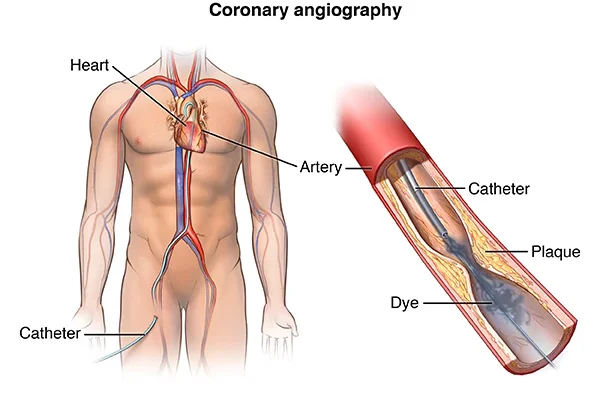
Coronary angiography is a minimally invasive imaging procedure used to visualize the coronary arteries. During the procedure, a thin catheter is carefully introduced through a blood vessel, commonly through the wrist or groin, and guided towards the heart. A contrast dye is then administered, allowing the coronary arteries to be clearly seen using X-ray imaging.
The procedure helps the cardiologist determine whether the arteries are normal, narrowed, or blocked and provides important information for deciding further treatment.
When Is Coronary Angiography Recommended?
A cardiologist may recommend coronary angiography when there is a concern about reduced blood flow to the heart. It may be considered for patients with:
- Persistent or recurrent chest pain
- Suspected coronary artery disease
- Abnormal ECG or cardiac test results
- Unexplained breathlessness
- Suspected or confirmed heart attack
- Significant findings on stress testing or other cardiac investigations
- Previously diagnosed coronary artery disease
- Evaluation before certain cardiac procedures
The decision to undergo angiography depends on the patient's symptoms, medical history, examination findings, and results of other investigations.
How Is Coronary Angiography Performed?
Before the procedure, the cardiologist reviews the patient's medical history, medications, allergies, kidney function, and relevant investigations. The patient is generally advised about any necessary preparation.
During coronary angiography, the access area is cleaned and local anaesthesia is administered. A thin catheter is inserted into a blood vessel, often through the wrist or groin. The catheter is guided towards the heart under imaging guidance.
A contrast material is injected into the coronary arteries. X-ray images are then taken to assess the movement of the contrast through the blood vessels. These images help identify areas of narrowing or blockage.
After the assessment is completed, the catheter is removed and the access site is carefully managed.
What Can Coronary Angiography Detect?
Coronary angiography can provide detailed information about the coronary arteries, including:
- Narrowing of coronary arteries
- Complete or significant blockages
- Location and extent of coronary artery disease
- Abnormal coronary blood vessel anatomy
- Blood flow through the coronary arteries
The findings can help the cardiologist decide whether the patient may benefit from medication, lifestyle management, angioplasty, stenting, bypass surgery, or another treatment strategy.
Benefits of Coronary Angiography
Coronary angiography offers several important benefits when clinically indicated:
Accurate Assessment
It provides detailed images of the coronary arteries and helps identify significant narrowing or blockages.
Treatment Planning
The results can help the cardiologist determine the most appropriate next step in treatment.
Minimally Invasive Procedure
Unlike open cardiac surgery, angiography is performed using a catheter inserted through a blood vessel.
Timely Cardiac Evaluation
In appropriate emergency and high-risk situations, coronary angiography can help rapidly evaluate the coronary arteries and guide further treatment.
Recovery After Coronary Angiography
Recovery depends on the patient's overall health and the type of procedure performed. After angiography, patients are generally monitored for a period to ensure that there are no immediate complications.
The access site should be kept clean and monitored for excessive bleeding, swelling, or increasing discomfort. Patients are usually advised to follow their cardiologist's instructions regarding physical activity, medications, hydration, and follow-up.
If angiography is followed by an intervention such as angioplasty or stent placement, the recovery and aftercare instructions may be different.
Why Choose Dr. Kamlesh Raut?
Dr. Kamlesh Raut is an experienced Interventional Cardiologist in Dwarka with advanced training in cardiac medicine. He completed his MD in Medicine from AIIMS, New Delhi, and DM in Cardiology from SGPGIMS, Lucknow.
His approach focuses on careful evaluation, evidence-based cardiac treatment, and clear communication with patients and their families. For patients requiring coronary angiography, he emphasizes appropriate assessment and individualized treatment planning based on the clinical condition and angiographic findings.
Frequently Asked Questions
1. Is coronary angiography painful?
Coronary angiography is generally performed under local anaesthesia. Patients may experience mild pressure or discomfort at the catheter insertion site, while the procedure itself is usually well tolerated.
2. How long does coronary angiography take?
The duration can vary depending on the patient's condition and the complexity of the examination. Your cardiologist can provide more specific information based on your individual case.
3. Is coronary angiography the same as angioplasty?
No. Coronary angiography is primarily a diagnostic procedure used to visualize the coronary arteries. Angioplasty is a treatment procedure used to open certain narrowed or blocked arteries.
4. Is coronary angiography safe?
Coronary angiography is a commonly performed minimally invasive cardiac procedure. Like any medical procedure, it carries potential risks, which your cardiologist will discuss with you before the procedure.
5. What happens if a blockage is found?
Depending on the location and severity of the blockage, treatment may include medicines and lifestyle changes, angioplasty with or without stent placement, or referral for bypass surgery when appropriate.
6. Who performs coronary angiography in Dwarka?
Dr. Kamlesh Raut is an experienced Interventional Cardiologist providing specialized cardiac evaluation and interventional care in Dwarka. The suitability of coronary angiography is determined after a detailed clinical assessment.