
Coronary Angioplasty and Stenting
Coronary Angioplasty and Stenting
Coronary angioplasty and stenting are minimally invasive procedures used to improve blood flow through narrowed or blocked coronary arteries. They are commonly performed for patients with significant coronary artery disease and, in appropriate cases, may be required during or after a heart attack.
Dr. Kamlesh Raut is an experienced Interventional Cardiologist in Dwarka, providing comprehensive evaluation and advanced cardiac care for patients with coronary artery disease. With his strong academic and clinical background, he focuses on selecting the most appropriate treatment based on each patient's symptoms, cardiac investigations, overall health, and severity of arterial blockage.
What Is Coronary Angioplasty?
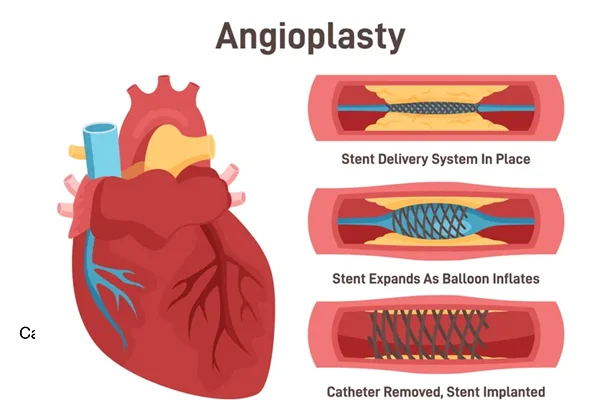
Coronary angioplasty, also known as Percutaneous Coronary Intervention (PCI), is a minimally invasive procedure used to open a narrowed or blocked coronary artery. The procedure is performed using a thin catheter inserted through a blood vessel, usually from the wrist or groin.
A small balloon at the tip of the catheter is positioned at the site of the blockage and carefully inflated. This helps widen the narrowed portion of the artery and restore blood flow to the heart muscle.
In many cases, angioplasty is combined with the placement of a stent to help keep the artery open.
What Is Coronary Stenting?
A coronary stent is a small mesh tube placed inside a narrowed coronary artery to help maintain blood flow. During angioplasty, the stent is positioned at the site of the blockage and expanded along with the balloon.
Once correctly positioned, the stent remains inside the artery and acts as a support structure. Most coronary stents used today are drug-eluting stents, which release medication designed to reduce the risk of the artery narrowing again.
When Is Angioplasty & Stenting Recommended?
Coronary angioplasty and stenting may be considered when a patient has significant coronary artery narrowing or blockage. Depending on the clinical situation, it may be recommended for:
- Significant coronary artery disease
- Persistent or recurrent angina
- Reduced blood flow to the heart
- Certain heart attack situations
- Significant blockage identified during coronary angiography
- Symptoms that remain despite appropriate medical treatment
- Selected patients with suitable coronary anatomy
Not every coronary blockage requires angioplasty. The treatment decision depends on the severity and location of the blockage, symptoms, heart function, overall health, and other clinical factors.
How Is Coronary Angioplasty Performed?
Before the procedure, Dr. Kamlesh Raut evaluates the patient's medical history, symptoms, cardiac investigations, medications, allergies, and other relevant health factors.
During the procedure, local anaesthesia is used at the catheter insertion site. A thin catheter is guided through a blood vessel towards the coronary arteries. Contrast dye and imaging are used to identify the affected artery and blockage.
A guidewire is carefully passed through the narrowed area. A small balloon may then be inflated to widen the artery. A stent is usually placed at the treated area when indicated. The stent expands against the artery wall and helps maintain an open pathway for blood flow.
After the procedure, the catheter is removed and the access site is managed carefully. The patient is monitored for recovery and given specific instructions regarding medicines and follow-up.
Benefits of Coronary Angioplasty & Stenting
Improved Blood Flow
The procedure can restore or improve blood flow through a significantly narrowed coronary artery.
Relief From Symptoms
In appropriate patients, angioplasty can help reduce symptoms such as angina and improve exercise tolerance.
Minimally Invasive Treatment
Angioplasty is performed through a catheter rather than through open-heart surgery.
Faster Recovery
Because it is minimally invasive, recovery can generally be quicker than recovery from major surgical procedures, although the exact recovery period varies between patients.
Treatment During Emergencies
In selected heart attack situations, emergency angioplasty can be an important treatment for restoring blood flow to the heart.
Recovery After Angioplasty & Stenting
After coronary angioplasty, patients are monitored for a period based on their clinical condition and the complexity of the procedure. The catheter access site may remain mildly sore or bruised for some time.
Patients are given specific instructions regarding medications, physical activity, diet, and follow-up. Antiplatelet medicines are particularly important after stent placement and should be taken exactly as prescribed. Patients should not stop these medicines without consulting their cardiologist.
A heart-healthy lifestyle, including regular physical activity as advised, a balanced diet, smoking cessation, weight management, and control of blood pressure, diabetes, and cholesterol, can also support long-term cardiovascular health.
Why Choose Dr. Kamlesh Raut?
Dr. Kamlesh Raut is a highly experienced Interventional Cardiologist in Dwarka with specialized training in cardiology and advanced cardiac care. He completed his MD in Medicine from AIIMS, New Delhi, followed by DM in Cardiology from SGPGIMS, Lucknow.
He currently serves as Senior Consultant – Interventional Cardiologist at Max Super Speciality Hospital, Dwarka. His previous experience includes working as a Consultant Cardiologist at Max Super Speciality Hospital, Shalimar Bagh, and as Assistant Professor of Cardiology at SGPGIMS, Lucknow.
Dr. Raut follows a patient-focused approach, carefully evaluating each case before recommending an appropriate treatment strategy. His focus is on evidence-based care, clear communication, and helping patients understand their condition and available treatment options.
Frequently Asked Questions
1. What is the difference between angioplasty and stenting?
Angioplasty uses a balloon to widen a narrowed coronary artery, while stenting involves placing a small mesh tube inside the artery to help keep it open. Both are often performed together.
2. Is coronary angioplasty a major surgery?
No. Coronary angioplasty is a minimally invasive catheter-based procedure and does not involve open-heart surgery.
3. How long does recovery after angioplasty take?
Recovery varies depending on the patient's health, the complexity of the procedure, and whether it was performed during an emergency. Your cardiologist will provide individualized recovery instructions.
4. Will I need medicines after getting a stent?
Yes. Patients who receive a coronary stent are commonly prescribed antiplatelet medicines and other cardiac medications. These should be taken exactly as directed by the treating cardiologist.
5. Can a blocked artery be treated without angioplasty?
In some patients, coronary artery disease can be managed with medicines and lifestyle changes. In others, angioplasty or bypass surgery may be more appropriate. Treatment depends on the individual's condition.
6. Who provides coronary angioplasty in Dwarka?
Dr. Kamlesh Raut is an experienced Interventional Cardiologist in Dwarka who provides specialized evaluation and interventional cardiac care. The need for angioplasty and stenting is determined after a detailed assessment.